
Support

Frequently asked questions

Clear answers to common questions about how Brandr works, what it measures, and how to get started.

Getting Started

What do I need to get started?

An email list of the audience you want to survey: your customers (for brandr Index) or your employees (for Employer Index). brandr provides the methodology, survey framework, and dashboard. You provide the audience.

How long does setup take?

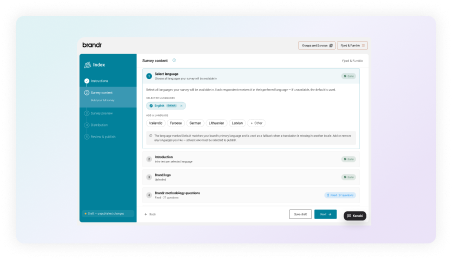
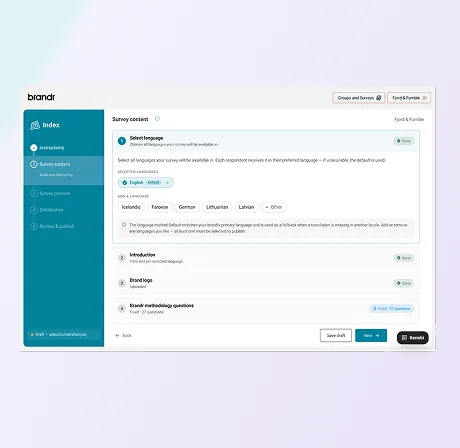
Less than 15 minutes. The survey methodology is pre-built and scientifically validated, so there's no need to design questions from scratch. Upload your list, review the setup, and launch.

In the case of Enterprise customers using panel data, setup can take 3-5 days.

How long does the full process take, end to end?

For most customers, results arrive within two weeks of launching the survey. Engagements that include addons such as Consumer Panel or Synthetic Panel data typically take longer, since sourcing and fielding through external panels adds time to collection and analysis.

How many respondents do I need?

For statistically robust results, we recommend at least 300 respondents for B2C brands, 25+ for B2B, and 15+ for the Employer Index. These aren't hard requirements. Larger samples give you stronger insights, and smaller samples can still provide valuable directional signals, especially for B2B or niche companies where the total audience is limited.

What response rate should I expect?

Response rates typically fall between 10% and 25%, with around 20% being a strong result. Rates above 30% are considered exceptional. As a rough rule of thumb, 500 invites will generate around 100 responses. You can boost participation with light incentives like a raffle.

How often should we measure?

Most companies run a full index measurement annually or biannually, with shorter pulse and wave surveys in between to track specific initiatives. brandr supports continuous tracking, so you can set a cadence that fits your strategy.

Do you provide the survey audience?

No. In around 90% of cases, clients use their own customer or employee lists, which is both more relevant and more cost-effective.  

For larger brands that need broader market reach, we offer Consumer Panel and Synthetic Panel data as addons on the Enterprise plan. The key principle is that respondents must already know your brand: this is not an awareness study.

Who is responsible for building the respondent list?

You are, in most cases, since you know your customers and employees best. For Enterprise engagements, we help structure the list and define relevant segments so the results are as meaningful as possible. For Starter and Growth plans, compiling and uploading the list sits fully with you.
What we measure

What's the difference between brandr Index and Employer Index?

brandr Index measures how your customers perceive your brand externally. It covers Differentiation (how unique your brand is), Segmentation (how well it reaches the right audiences), Perception & Image (how people experience it), and Social Responsibility (including ESG and trust factors).  Employer Index measures how your employees perceive the brand internally across three dimensions: Branding, Human Resources, and Equality.  Together, they give you a full 360° view of brand health.

What questions does the survey ask?

Both indexes use structured surveys of validated questions covering the key drivers of brand perception. The brandr Index focuses on external drivers like image, differentiation, and segmentation, going well beyond simple awareness. The Employer Index focuses on internal drivers across branding, human resources, and equality, covering how employees experience the company as a brand. Every question is tested for reliability and validity.

How long is the survey for respondents?

Around four minutes for each index.

How is brandr Index different from NPS or awareness tracking?

NPS measures loyalty. Awareness tracking measures visibility. brandr Index measures why people trust, prefer, and connect with your brand, which is the underlying layer of drivers that NPS and awareness scores can't explain on their own.

How often should we run surveys?

That depends on your goals. Many companies run a full measurement quarterly or biannually, with shorter pulse surveys in between to track specific initiatives. brandr supports continuous tracking so you can set a cadence that fits your strategy.

Results and Insights

What metrics and scores will I get?

Your dashboard includes an overall brandr Score and dimension-level scores for each index. You'll also see the key elements driving each score, plus core indicators like Recommendation Score, Trust Score, and Loyalty Score, with demographic breakdowns.

What kind of insights will I get?

Beyond scores, brandr shows you which brand attributes are driving your key metrics, where you're strong, and where there's room to improve. On Growth and Enterprise plans, the Impact Matrix reveals which levers to pull, and demographic breakdowns show how different segments perceive your brand.

How are results delivered?

Through an interactive, real-time dashboard. You can explore your data, filter by demographics, track trends over time, and drill into specific dimensions whenever you need to.

Can I use the results to guide strategy?

Yes, that's the point. brandr is built for action, not just reporting. On Growth and Enterprise plans, Strategic Recommendations translate perception data into prioritised actions, showing you exactly what to focus on to strengthen your brand, reduce risk, and grow sustainably.

Can we benchmark against similar companies?

Yes. brandr provides benchmarking across dimensions, scores, and individual elements so you can see how your brand compares within your category and market. Note that benchmarking against named individual brands is not possible. Benchmarks are built from anonymised, aggregated data.

Methodology

What is the methodology based on?

The indexes are built on established brand equity models from academic branding theory, validated in practice across dozens of brands and hundreds of measurements. Rather than inventing a proprietary framework, brandr operationalises peer-reviewed research on how brand perception forms and how it drives behaviour, and turns it into a repeatable measurement system.

Who developed the methodology?

brandr's methodology was developed by our founder, Dr. Fridrik Larsen, a branding specialist with a background in psychology and finance. His PhD research at Aston Business School focused on energy branding, and it was during that work that he identified a gap in how brand positioning was being measured.  The first version of the framework, then called the Energy Branding Benchmark Index, was developed in 2008 and refined over several years into the 30-question survey at the core of brandr Index today. The beta launched to customers in 2016, and the methodology was generalised beyond the energy sector in 2020. His psychology background shapes how the framework captures consumer perception, and his finance background shapes the rigour and data discipline behind the scoring.

How are the survey questions validated?

Every construct and question is tested for reliability and validity before it enters the live survey. That means we check whether questions consistently measure what they're supposed to measure (reliability) and whether they actually capture the underlying concept we care about (validity). Questions that don't meet the bar are revised or removed.

How is statistical reliability ensured?

Reliability comes from three things working together: a validated question set, a sufficient sample size (see our respondent recommendations in Getting Started), and a representative audience. When all three are in place, results are statistically robust and directly comparable across waves and against benchmarks. For smaller B2B samples where full statistical robustness isn't possible, we're transparent about treating the results as directional rather than definitive.

How are benchmarks calculated?

Benchmarks are built from anonymised, aggregated data across all brands measured on the platform within a given category or market. As more brands run measurements, benchmarks become richer and more precise. Individual brand data is never exposed in benchmarks; you see category and market averages, not competitors by name.

How is brandr different from traditional brand tracking?

Traditional brand tracking tells you what happened: awareness went up, consideration went down. brandr tells you why, and what to do next. By measuring the underlying drivers of perception (differentiation, trust, emotional connection, alignment, and so on) and showing which ones move your headline metrics, the platform converts measurement into action rather than reporting.

Privacy and Data

How do you handle our data?

All survey data is handled securely and in compliance with applicable data protection regulations. We use your data to form industry and category benchmarks through anonymised aggregation. Your data will not otherwise be shared with third parties without your explicit consent.

Are survey responses anonymous?

Yes. Individual responses are anonymized in the reporting. Your respondents' identities are protected.

Is the platform secure?

Yes. We follow industry-standard security practices to protect your data, including encryption and access controls. If you have specific compliance requirements, get in touch and we'll walk you through the details.

INSIGHTS

From Insights to Action.

Brandr provides a structured 4-step decision framework for brand leaders.

1. step

Send Your Survey

Collect focused insights from customers and employees using a survey designed around your strategic priorities. It’s ready to send and takes just 4 minutes to complete, making it easy to gather meaningful feedback quickly.

2. step

Analyze Results Instantly

Access real-time analytics that translate raw responses into clear indicators of brand health, perception, and alignment.

3. step

Identify What Matters Most

Brandr highlights patterns and priority areas in the data, helping you understand what deserves attention and where to focus for the greatest impact.

4. step

Take Action

Act on insights with confidence. Track progress over time and evaluate whether decisions are improving alignment and performance.

Get Started

Start with a clear view of your brand.

Thank you! Your submission has been received!
Oops! Something went wrong while submitting the form.