




Board pressure on marketing has intensified. In the Spring 2025 CMO Survey, 63% of marketing leaders reported increased pressure from their CFO to prove the value of marketing, up from 52% in late 2023, and demonstrating marketing's impact on financial outcomes remains their single biggest challenge. Separate Gartner research found that only 27% of CEOs and CFOs feel their CMO exceeded expectations last year. The instinct in most companies is to respond by collecting more numbers. The harder truth is that brand measurement rarely fails because there is too little data. It fails because the data is fragmented, occasional, and disconnected from the decisions it is supposed to inform. Getting it right is less about adding metrics and more about building a structure that holds them together.
What brand measurement actually means
Brand measurement is often treated as a single number, usually awareness, tracked once or twice a year, and reported as a headline. That definition is too narrow to be useful. A brand exists in the minds of the people who encounter it, and what they hold in mind is layered. Measuring it properly means accounting for those layers rather than collapsing them into one figure.
Awareness, perception, and behavior
There are three distinct things worth measuring that are frequently confused.
The first is what people know: whether they have heard of you, and whether you come to mind in the moments that matter.
The second is what people think: what they associate with you, how they judge you against alternatives, and whether they trust you.
The third is what people do: whether perception translates into consideration, choice, and loyalty.
Awareness without favorable perception produces recognition that never converts. Perception without behavior suggests a gap somewhere between intention and the actual purchase. Each layer tells you something the others cannot, which is why a measurement approach built on any one of them in isolation gives an incomplete reading.
Why a single metric is never enough
A single metric is appealing because it is easy to report and easy to compare over time. The problem is that it carries no diagnostic information. If awareness is high but sales are flat, a single number cannot tell you whether the issue is weak differentiation, a perception problem, or a category that is simply not growing.
Brand measurement earns its place when it can explain movement, not just record it. That requires more than one signal, structured so the signals can be read against each other.
Why most brand measurement falls short
Most organizations do measure something. The shortfall is rarely a total absence; it is that the measurement in place does not survive contact with a real decision. A few recurring patterns explain why.
- Measurement happens too infrequently to catch change while it still matters
- A single proxy metric stands in for the whole picture
- Findings arrive in a format that the rest of the business cannot use
- Results describe what happened without explaining why
Measuring activity instead of perception
Most teams substitute activity data for perception data. Impressions, reach, engagement rates, and follower counts are abundant and easy to pull, so they fill the gap where perception measurement should sit. None of them describes what people actually think about the brand.
A campaign can generate millions of impressions and shift perception, not at all, or shift it in the wrong direction. Activity metrics measure what the brand did. Brand measurement should describe what changed in the people the brand was trying to reach.
One-off studies that age badly
A brand study commissioned once a year captures a single moment and then slowly goes stale. Perception moves continuously: a competitor launches, a news cycle turns, a product issue surfaces. By the time the annual study lands, the market may have already shifted. This is the structural argument for measuring on an ongoing basis rather than in occasional bursts.
Data that never reaches the boardroom
The third failure is one of translation. A great deal of brand research is methodologically sound and commercially invisible, because it never leaves the marketing team in a form anyone else can act on. If the output is a hundred-slide deck that a brand manager understands and a CFO does not, the measurement has failed at the exact moment it was supposed to matter.
NIQ's 2026 CMO Outlook, based on a survey of more than 250 marketing leaders, found that 54% of CMOs cite connecting data across different sources as a major barrier to generating insight, and only 37% have a central repository that the whole business can reach. Measurements that cannot travel are not used.
The dimensions a complete brand measurement system covers
If awareness alone is too thin, the question becomes what a fuller picture includes. A complete system treats perception as multi-dimensional, measuring several distinct things that together explain how a brand sits in its market. Social responsibility and sustainability perception, increasingly material to how brands are judged, belong in that picture too. The three dimensions below are where most of the diagnostic value lies.
Differentiation and how distinct you really are
Differentiation is the dimension companies most often assume rather than measure. Leadership tends to believe the brand is distinct because the strategy documents say it is. The market frequently disagrees. Measuring differentiation means asking whether customers can actually tell you apart from the alternatives, and on what basis.
A brand that scores well on awareness but poorly on differentiation is recognized without being preferred, which is an expensive position to hold. This is the dimension that most directly connects to pricing power and resistance to competition.
Perception, image, and the gap between them
An image is what a brand projects. Perception is what the market receives. The distance between the two is one of the most useful things a measurement system can provide. A company may intend to be seen as premium and innovative, while the market reads it as expensive and conventional. Neither the intended image nor the received perception is the full story; the gap between them is where the actionable insight lives. Closing that gap is often a clearer brief than a vague instruction to "strengthen the brand," and it gives creative and strategy work a measurable target.
Segmentation: perception is not uniform
A single average perception score hides as much as it reveals, because perception is rarely uniform across audiences. The segment you most want to win may see you very differently from the segment you already serve. Measuring perception by segment shows where the brand is strong, where it is vulnerable, and where the opportunity to grow actually sits. An aggregate number that looks healthy can disguise serious weakness in the exact group that matters most to future growth.
Connecting brand metrics to commercial outcomes
The reason this structure matters is that brand perception is not a soft concern sitting apart from the financials. It is a leading indicator of them. The challenge for most brand leaders is making that link explicit enough to survive a budget conversation.
What the long-term effectiveness data show
The most substantial evidence base here is the IPA Databank, analyzed over three decades by Les Binet and Peter Field across hundreds of effectiveness case studies. Their work established the now widely cited 60:40 principle: that around 60% of the marketing budget is best directed toward long-term brand building and 40% toward short-term activation, because brand building drives the larger and more durable commercial effects.
At the 2025 IPA Effectiveness Conference, Binet presented further analysis arguing that budget scale is roughly eight times more important than short-term ROI in driving overall effectiveness, a finding that runs directly counter to where most boards currently apply pressure. The evidence consistently shows that brands that invest in and sustain perception outperform those that chase only immediate response.
Why perception predicts revenue
Perception predicts revenue because it shapes decisions before they are made. A brand that is differentiated, trusted, and salient enters the consideration set more often and converts at a lower cost because persuasion has already occurred. When perception weakens, the effect shows up later in the funnel as rising acquisition costs and softening pricing power, often months after the perception itself shifted.
The risk of measuring too little is now quantified: Gartner research found that 84% of companies are caught in a "brand doom loop," a cycle in which underfunded measurement leads to unclear impact, which breeds C-suite skepticism, which further tightens budgets. Companies stuck in that loop were found to be half as likely to exceed their growth targets as those that can credibly evaluate brand value. Measuring perception continuously turns a lagging financial signal into a leading one and keeps a brand out of that loop.
Treating brand measurement as a structured input
Once perception is understood as multi-dimensional and commercially predictive, the practical question is how to make it a routine input to decisions rather than an occasional report. That means measuring the right dimensions consistently, benchmarking against competitors rather than only against your own history, and presenting the result in a form the whole business can read.
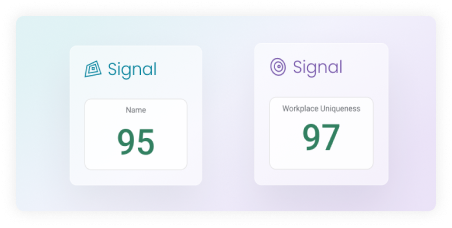
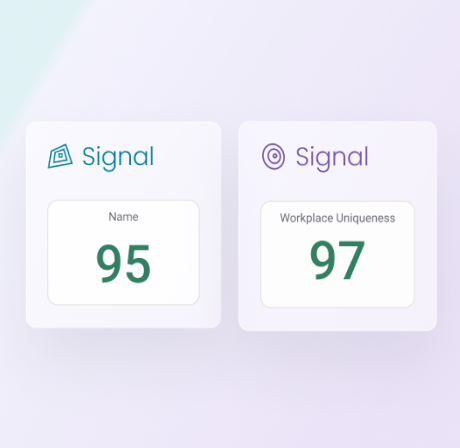
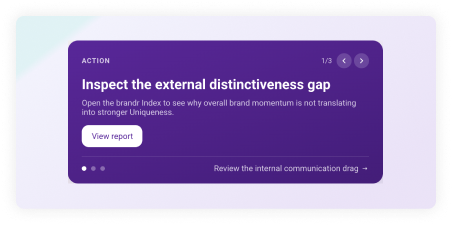
This is the principle behind Brandr: it measures brand perception across four validated dimensions and sets the results against industry benchmarks, so a brand leader can walk into a planning conversation with structured evidence rather than instinct. The shift is not from no data to more data; it is from scattered signals to a single, comparable picture that holds up under scrutiny. For the competitive side of that picture specifically, structured brand benchmarking is what turns an internal score into a market position.
Where this leaves brand leaders
The pressure to prove the value of brand work is not going to ease, and the teams that struggle will be the ones still reporting a single number once a year. The ones that do well will treat brand measurement as a system: layered, ongoing, segmented, and tied to commercial outcomes they can defend. Perception is already shaping the business results that boards care about, whether or not it is being measured well. Building the structure to see it clearly is what lets a brand leader stop explaining the past and start influencing the decision in front of them.


.jpg)
.jpg)