




Almost every marketing team is aware of its competition. Fewer are actually measuring how their brand is perceived in relation to it. Most of what gets called competitive benchmarking inside marketing functions tracks activities, what competitors are pricing, posting, or spending, rather than the harder question of how the market sees one brand against the others. That gap matters because a brand can match or outspend a competitor on every visible activity and still lose ground in the way buyers actually think about the category. Proper brand benchmarking measures perception, not output, and it changes what a marketing leader can see about their position in the market.
What brand benchmarking actually compares
Brand benchmarking is the structured comparison of how your brand is perceived against the brands you compete with, across the dimensions that shape buying behavior. It is not the same as tracking what competitors do, although the two are often conflated. The activities a competitor undertakes are easy to observe from the outside. Their perception in the minds of customers and prospects is not, and that perception is what determines whether the activities translate into preference, consideration, or choice.
Activity benchmarking versus perception benchmarking
The distinction matters because the two answer very different questions. Activity benchmarking tells you what your competitors are doing: how often they post, what they spend on paid media, how their pricing compares, and which keywords they rank for. This information is useful, but it describes inputs, not outcomes. Perception benchmarking tells you what those activities are producing in the minds of the market: whether buyers see your competitor as more distinct, more trusted, or more aligned with what they care about. Activity data is widely available and tempting to rely on, precisely because perception data takes more effort to collect. The teams that benchmark only on activity end up confidently informed about what competitors are doing and quietly blind to whether any of it is working.
Why most brand benchmarking fails to be useful
When brand benchmarking does happen, the version most organizations run rarely produces decisions. The data gets collected, presented, and filed, without changing what the team actually does the next quarter. A few patterns explain why benchmarking ends up at this dead end.
- The comparison is to the brand's own past rather than to competitors in the same market
- The metrics being benchmarked are convenient rather than diagnostic
- The reading is taken once a year and is already stale by the time it is shared
- Findings arrive without a clear link to a decision anyone is about to make
Comparing your brand only to its past self
A common form of weak benchmarking compares the brand only against its own previous results. Awareness is up three points, consideration is flat, and satisfaction is slightly improved year over year. These numbers feel like progress, and they may be, but without an external comparison, they tell you nothing about market position. A brand can improve every internal metric while losing share to a competitor that is improving faster. Benchmarking against your own history is a useful baseline; it is not benchmarking. A real comparison requires placing your numbers next to those of the brands you are actually competing with.
Benchmarking the wrong things
The second common failure is benchmarking whatever is easy to measure, rather than what actually predicts brand strength. Impressions, share of voice on social, ad spend, posting frequency, follower counts: all of these are collectible, and none of them describe how a brand is perceived. A team that benchmarks only these superficial signals will know precisely how their activity volume compares to competitors, but learn very little about whether the brand is gaining or losing ground in the minds of the people who buy.
Tracking volume-based metrics like impression counts fails to explain why a brand wins or loses on that crucial day-one shortlist. A team that benchmarks only these superficial signals will know precisely how their activity volume compares to competitors, but learn very little about whether the brand is gaining or losing ground in the minds of the people who buy.
Benchmarking earns its keep only when it measures the things that move buying decisions: whether the brand is seen as distinct, whether it is associated with the attributes that matter to buyers in the category, and whether it comes to mind when those buyers are ready to act. Those are harder to track than impression counts, and they also determine whether the impressions ever convert into anything.
What good brand benchmarking measures
Useful brand benchmarking looks at several dimensions of perception simultaneously rather than collapsing the comparison into one figure. A single composite score can hide too much, particularly when a brand is strong on one dimension and weak on another that matters more to the segment it is trying to win. The dimensions that consistently carry diagnostic value tend to fall into a few clear categories.
The dimensions worth comparing
The dimensions worth tracking against competitors are the ones that connect to commercial outcomes. Three tend to show up across credible benchmarking approaches:
- Differentiation: how distinct the brand is perceived to be from its competitors
- Perception and image: what attributes the market associates with the brand, and how those compare to associations held about competitors
- Salience: how readily the brand comes to mind in the relevant buying moment
The principle behind all three is the same: benchmarking is most useful when it tells you not just how you compare overall, but on which specific dimensions you are winning and which ones you are losing. A single composite score can hide too much when one dimension is strong and another, more critical to the segment you want to win, is weak.
Brand benchmarking as a strategic input, not a report
Most of the failures described above share a common root: benchmarking is treated as a one-time project rather than a continuous read. A team commissions a study, receives findings months later, presents the deck, and then waits a year before doing it again.
By the time a traditional annual study lands, the competitive picture has already shifted in ways a static report cannot capture, forcing teams to make critical decisions on instinct between readings.
For benchmarking to actually shape strategy, it has to be structured enough to be comparable across reads, consistent enough to track movement over time, and frequent enough to catch shifts while there is still room to respond.
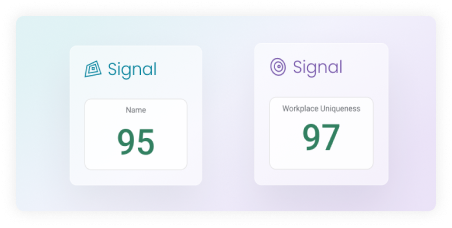
This is the role Brandr plays for marketing leaders, measuring brand perception across four dimensions: Differentiation, Segmentation, Perception and Image, and Social Responsibility, and setting the result against industry benchmarks so the comparison is built into the read rather than commissioned separately. What changes in practice is not just the format of the data but the kind of question it can answer.
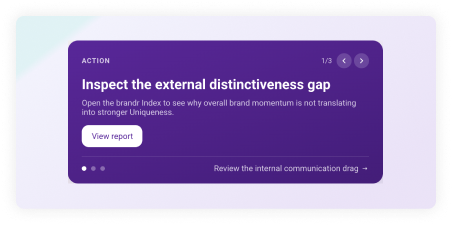
A team can see whether they are gaining or losing on a specific dimension against named competitors, identify which dimension is driving the gap, and brief work against that finding rather than against a general sense that something is off. The output is not another annual deck filed away after a quarterly meeting. It is a structured baseline that updates over time, so a brand leader can see where competitors are gaining ground while there is still room to respond, rather than reading about the shift in next year's review. The shift this enables is from benchmarking as a backward-looking report to benchmarking as a live input into the decisions a marketing team is making this month.
Where this leaves brand leaders
Competitors are not going to stop moving, and the brands that hold position will be the ones that know, in real terms, how they compare on the dimensions that drive choice. The version of brand benchmarking that compares only to your own past or tracks only what competitors do will keep producing reports that feel informative and rarely change anything. The version that measures perception against competitors, across the dimensions that matter to buyers, gives a marketing leader something different: a clear read of where the brand actually stands in the market, and the evidence to act on it before the next quarter quietly tells the same story through softer numbers.


.jpg)
.jpg)