



.jpg)
Most agencies already know the research methods available to them. In-depth interviews, focus groups, surveys, ethnographic observation, brand tracking, competitive analysis — the toolkit has been mapped extensively, and any strategist working in brand has been through it. The harder problem is not choosing a method. It is defending that choice in front of a client's board, where the people signing the invoice want to know why this method, why now, and why not something cheaper. A method that works technically but cannot be defended commercially will keep losing to a method that costs less and produces less. Agencies that set pricing and run engagements treat defending the method as part of the work, not an afterthought.
What counts as brand research methods
Any list of brand research methods will fall into two useful splits: primary versus secondary, and qualitative versus quantitative. Understanding the four quadrants those splits produce matters less as a taxonomy and more as a way to reason about what a given method can and cannot tell you. The definition worth carrying into a client conversation is that brand research methods are the specific ways an agency generates evidence about how a brand is understood, felt, and chosen, not the tools that produce that evidence.
Primary and secondary, qualitative and quantitative — brief but useful
Primary research generates data the agency collects directly, through surveys, interviews, or observation. Secondary research analyzes data that already exists, whether internal client data, published industry research, or platform analytics. Qualitative research produces text, transcripts, and interpretation, and it answers questions of meaning: what does this segment associate with the brand, and why. Quantitative research produces numbers and answers questions of magnitude: how many, how much, how often, how compared. In practice, serious brand work tends to blend all four, because a single quadrant produces a partial picture. Where agencies get into trouble is treating any one of them as the default rather than the appropriate response to the specific question being asked.
Why method choice looks arbitrary to clients
From inside the agency, the method choice usually makes sense. The team has done this before, they know what works, and they select what fits the brief and the budget. From outside the agency, particularly from the seat of a CFO or a skeptical board member, the same choice can look opaque. If the agency proposes focus groups and the finance lead asks why not an online survey at a fraction of the cost, the honest answer, that focus groups produce depth a survey cannot, is rarely enough on its own. What the board wants is a reason grounded in the specific decision the research is supposed to inform. If the agency cannot articulate that link, the method looks like preference, and preference gets negotiated down.
This is where a lot of proposed research dies. Not because the method is wrong, but because the case for it never made contact with what the client was actually trying to decide. Agencies that lose research budget in the tightening rounds tend to be the ones that argue the method on its merits, when what they needed to argue was the decision it was designed to unlock.
Matching the method to the question
The strongest position an agency can take into a client conversation is to work backward from the question the client needs to answer. When the method is presented as the response to a specific business question rather than as a preferred technique, it becomes far harder to argue against. That principle sounds obvious, but in practice it means resisting the temptation to lead with the method the agency is most comfortable delivering and starting instead with the shape of the decision at stake.
The mapping between questions and methods is not exotic. Most brand questions fall into a small number of categories, and each category has a natural, defensible method:
- Positioning against competitors: quantitative brand perception measurement with a comparative sample
- Emotional or associative meaning of the brand: qualitative interviews or moderated discussion
- Change in perception over time: repeated quantitative measurement against a consistent baseline
- Diagnosis of a specific perception gap: a mix, starting with quantitative to locate the gap and qualitative to explain it
When a question needs numbers and when it needs stories
Numbers answer questions of scale and comparison, and they are what a board tends to trust when a spending decision is on the table. Stories answer questions of meaning, and they are what a strategy team needs to write a brief that changes behavior. Neither is a substitute for the other, and the failure mode of most brand research is choosing one when the question required both. When an agency proposes a mixed approach and explains which half of the evidence answers which half of the question, it stops looking like an upsell and starts looking like rigor.
Building the case a client will accept
The case for a method is not made in research language. It is made in decision language. A finance director does not want to hear about statistical significance or thematic saturation. They want to hear that the method produces evidence they will be able to defend when the decision it informs comes back for review.
Translating the technical case into the commercial one is a real skill, and it separates agencies that lose scope from agencies that hold it. The version of that translation that consistently works ties the method to the specific downstream decision, names the risk of using a weaker method, and quantifies where possible.
Where good methods still fail to inform strategy
Even when the method is well chosen and well defended, the research can still fail to inform the strategy it was meant to shape. This is the failure that shows up not in the proposal stage but months later, when the findings have been delivered, and nothing about the client's brand work has changed. The gap between what the research shows and what the client actually does with it is where a lot of methodologically sound work quietly dies.
The gap between research and recommendation
The most common cause is that the research is delivered as findings rather than as a set of recommendations tied to the findings. A report that says "the market perceives the brand as expensive relative to peers" is a finding. A report that says "the perception of being expensive is concentrated in the segment you are trying to win, and the closing recommendation is to lead with value-anchored positioning in that segment for the next two quarters" is a recommendation. Clients act on the second and file the first, and the agency that consistently delivers the second becomes a strategic partner rather than a research supplier. Method quality is the foundation of that shift, but it is not the whole of it.
Building brand research methods into a consistent offer
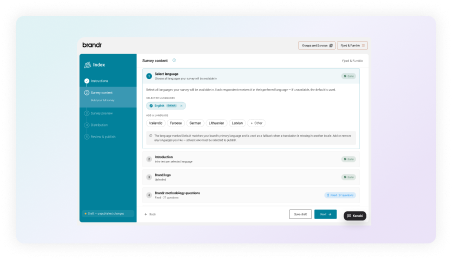
For an agency, the practical question is how to make brand research methods part of a standard offer rather than a fresh negotiation on every project. This is where a platform like Brandr fits into a consulting practice, giving the firm a consistent framework for measuring how a client's brand is perceived across dimensions and against competitors, so the research layer is ready to inform recommendations rather than being commissioned each time separately.
What changes for the agency is the sales conversation. The method is no longer something to defend from scratch on every pitch. It is a repeatable piece of the offering, benchmarked and comparable, which is much easier for the client to say yes to and much harder for the client to negotiate down.
The agencies that hold the research budget
The agencies that hold ground on research budgets in the next few years will not be the ones with the most sophisticated methods. They will be the ones that can defend the methods they choose in language a board understands, tie those methods to specific decisions the client needs to make, and deliver findings that arrive already translated into recommendations. Brand research methods are the substance of what an agency sells, and the agencies that treat the case for the method with the same seriousness as the method itself are the ones that keep getting hired for it.


.jpg)