



Partway through an annual review, a client's finance director asks the agency what the brand is worth. There are two ways to answer. One is a valuation figure, the financial amount valuation firms publish in their yearly rankings of the most valuable brands. The other is a read of brand strength, meaning what buyers think of the brand and how firmly they prefer it, and that is where most of an agency's work on measuring brand value takes place.
For agencies and consultants, the answer they choose decides what happens after the meeting. A valuation figure answers a question the finance team is asking. Brand strength shows the client's brand team where to put the next budget, which makes it the part of brand value a client can act on.
First come the two meanings of brand value and how they connect. After that comes the reason a valuation figure rarely changes what a client does next. The last part sets out a four-step way to measure brand strength, with each finding passed to the person on the client side who can act on it.
Two things a client can mean by brand value
The valuation figure
Brand valuation assigns a monetary figure to a brand, treating it as an asset with a price. ISO 10668 is the international standard for this work. It sets out how a brand's monetary value should be measured and how the result should be reported. The methods fall into three approaches. The income approach looks at what the brand is expected to earn, the market approach at what comparable brands sell or license for and the cost approach at what it would take to build the brand again.
Brand strength
A valuation also has to account for how people behave toward the brand. Alongside market and financial data, ISO 10668 lists behavioral aspects among the inputs a valuer has to consider, and this is where brand strength enters the figure.
Brand strength has its own standard too. ISO 20671-1, published in 2021, covers brand evaluation and gives a framework of inputs, output dimensions and sample indicators. A company can use it to assess its own brand, and an outside party can use it to assess someone else's.
For agencies, brand strength is where measuring brand value becomes client work. It's made up of things a brand team can influence, such as whether buyers see the brand as different from its competitors and how well it suits the segments it targets. Those perceptions are part of what the behavioral side of a valuation looks at, so a client who improves them is working on both meanings of brand value at once.
Why don't clients act on a valuation figure?
A valuation figure tells a client what the brand is worth, but it doesn't show which part of the brand is holding that number up or pulling it down. The brand team gets a total with nothing underneath it to work on.
The figure also moves for reasons that have nothing to do with the brand team's work. Under the income approach, the value rests on what the brand is expected to earn, so a new revenue forecast can change it even when buyers see the brand exactly as they did last year. A positioning change or a rebrand, on the other hand, can take a long time to show up in earnings, and by then too much else has changed to tie the result back to the work.
For an agency, that makes the valuation figure a weak basis for a recommendation. It can show the client's leadership what is at stake, and it has its place in finance discussions. But it won't tell the agency which part of the brand to work on first, and a year later it won't show whether that work paid off.
Measuring brand value through brand strength avoids these problems. When a read shows that buyers in a key segment see the brand as no different from its competitors, the client knows what the problem is and which team should fix it, and the next read will show whether the fix worked.
Measuring brand value for a client, step by step
These four steps work with any survey or platform, and they keep the client's finance and brand teams working from the same results.
1. Agree which question the client is asking
Measuring brand value starts with finding out who asked the question and why. A CFO preparing for an acquisition or a licensing deal needs a valuation figure, and that work belongs with a valuation specialist. A CMO who wants to know whether the brand is getting stronger, or how to allocate the next budget, would benefit more from a brand strength report. Clients often mean the second even when they phrase it as the first, so it's worth settling this before any survey goes out.
2. Measure brand strength by dimension
Break brand strength into the parts a team can work on:
- How buyers perceive the brand
- Whether they see it as different from its competitors
- How well it fits the segments the client targets
- How they judge the company's conduct
Score each part on its own and compare it with competitors in the same category, since a score means little until it sits next to theirs. Setting up structured brand benchmarking keeps that comparison consistent from one read to the next.
3. Tie each finding to a number the client already reports
Brand strength results get more attention when they sit next to figures the client's leadership already tracks. Before the results come in, agree which business figure each part of brand strength will be read against. For example:
- Whether buyers see the brand as different, next to how much the client discounts to win deals
- How well the brand fits a target segment, next to the client's sales or market share in that segment
- How buyers judge the company's conduct, next to customer retention and job applications
- Whether buyers would recommend the brand, next to referrals and repeat purchases
A single read can't prove that one drives the other, so the value comes from tracking these pairs over several reads and showing the finance team whether brand strength and the business figures move together.
4. Give every finding an owner and a date
Present each weak result as a task: what the finding is, which team on the client side owns it, what they'll change and when the next read will check it. A finding without an owner usually stays in the report. Run the next survey with the same questions and the same audience, so the client can compare the two reads directly and the agency can show what its work changed.
Where brandr fits in agency client work
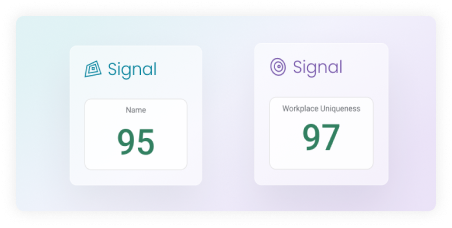
The four steps work with any survey, and brandr Index is built around the same structure. It measures brand strength across four dimensions: Perception, Social Responsibility, Differentiation and Segmentation. These match the four parts in step 2. The overall Score, from 0 to 100, is the average of the four. The Recommendation score runs from -100 to +100 and is the share of Ambassadors minus the share of Detractors, with Neutral respondents in between. That gives the last pairing in step 3 a number to track.
Benchmarks drawn from more than 15,000 responses across more than 50 industries sit next to every dimension, so the client can see where it stands in its category without commissioning a separate study. The methodology page explains how the scores are built.
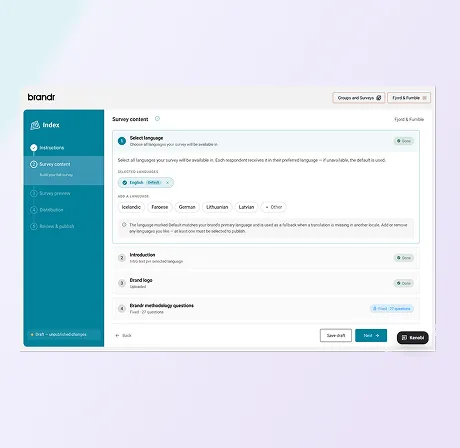
For agencies measuring brand value across several clients, the main gain is that every client brand is measured on the same framework. Results can be compared across accounts and across reads, and the client keeps ownership of its brand data. The survey takes about four minutes to answer, setup takes about 15 minutes and the first results arrive in about two weeks, which makes it practical to run a baseline before any strategy is written.
Giving clients a brand value they can use
When a client asks what the brand is worth, the agency's first job is to find out which answer they need. A valuation figure has its place in finance discussions, but the work an agency can deliver and report on starts with brand strength. Measuring brand value this way gives the client scores it can compare with competitors, findings tied to figures its leadership already watches and an owner for every weak result.
For the agency, measuring brand value through brand strength also means having a baseline before the project starts and a record of what changed after it, which makes the next recommendation easier for the client to approve.
The free trial of brandr covers one survey per product, with no card and no time limit, so an agency can build a client's first survey before committing to a plan. Start a free trial to build your next client's first survey.